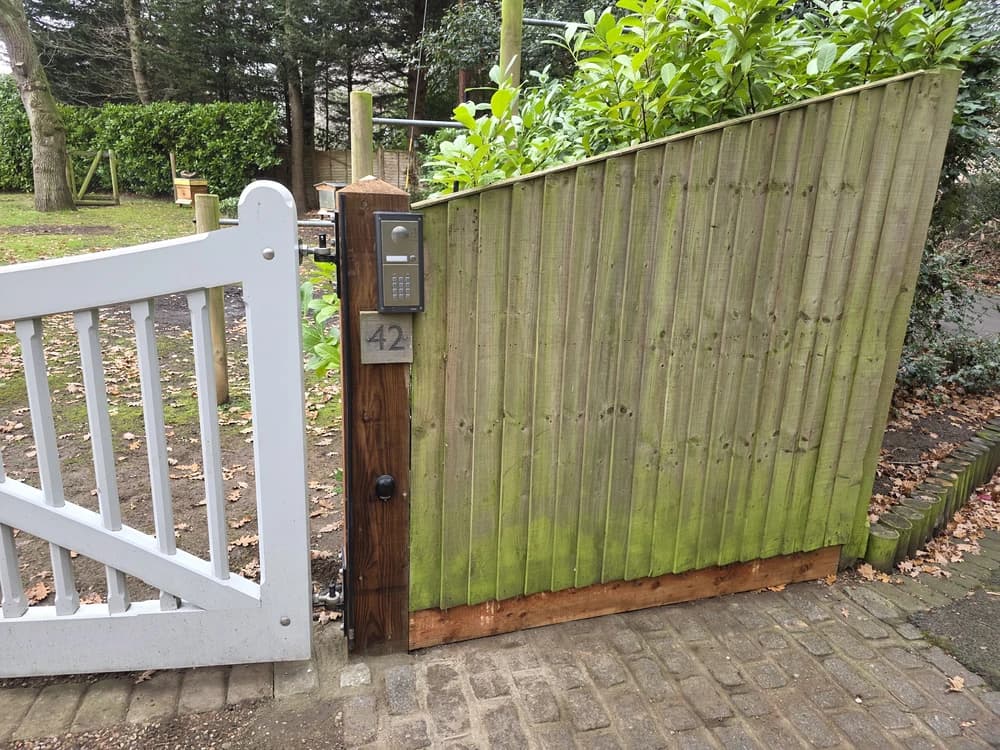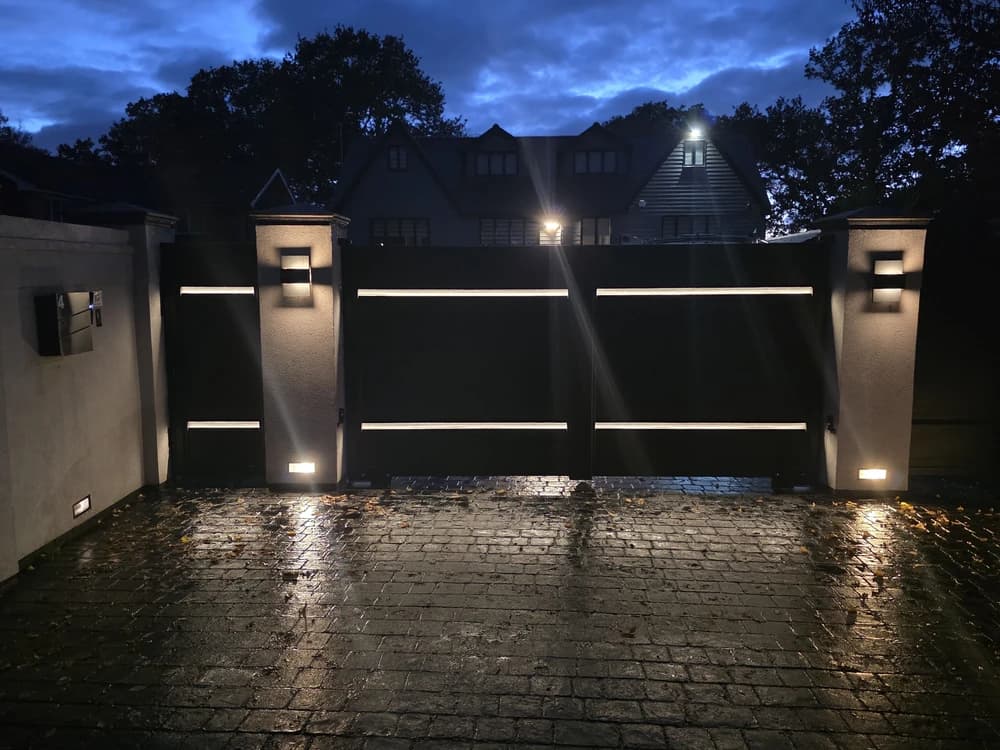
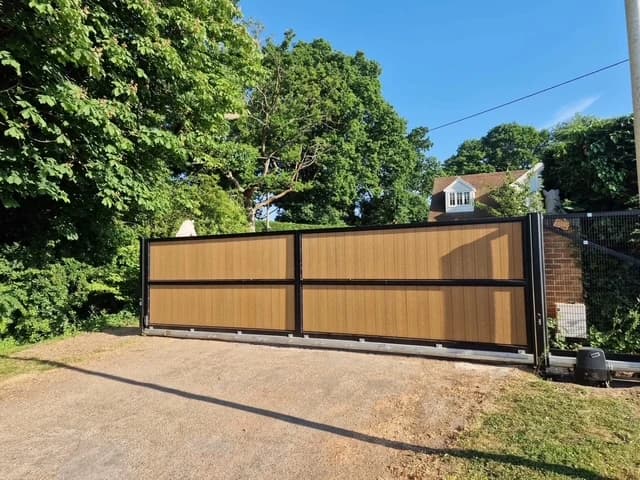
Nearly every driveway gate enquiry we get starts with a look, not a mechanism. Someone's seen a double-swing estate gate they like, or a long sliding gate on a barn conversion, and they want that. Fair enough. But the gate that suits your drive isn't decided by the photo. It's decided by your space, your gradient, and how the gate has to move to open. Get that wrong and you've either got a gate that fouls on the gravel, or one that needs a 6m strip of clear ground you simply don't have.
So before you fall for a finish, here's how we actually work out whether a driveway wants a sliding gate or a swing gate. Same questions we ask on every site survey.
Swing gates need room to swing, and most drives have less than you think
A swing gate opens through an arc. A single 3m leaf, or a pair of 2.4m leaves on a double-swing, sweeps a quarter circle into your drive or out towards the road. Out towards the road is rarely allowed and never sensible, so the arc almost always comes inwards. You need that space clear. No parked car, no wheelie bin, no raised bed in the way.
The bigger trap is the ground itself. A swing gate hangs at a fixed height off its hinges, so the bottom rail stays level as it travels. If your drive rises away from the gateway, even gently, the leaf will clip the rising ground partway through its arc. We see it constantly on sloped Cotswold and home-counties drives. The fix is either a swing that opens the other way, hanging the gate higher (which leaves an ugly gap underneath), or a rising-hinge setup that lifts the leaf as it opens. All of that is fiddly and adds cost.
Gravel's the other one. A swing gate over loose gravel will plough a furrow within a month unless you've a hard, level swept arc under it. People forget the gate has to clear its own travel path, not just sit there looking good.
- Slopes that rise into the property are the single most common reason a swing gate won't work as drawn.
- Loose gravel and a ground-clearing swing leaf are a bad match without a hard sweep arc.
- Need the parking right up to the gateline? A swing gate eats that space every time it opens.

Sliding gates trade swing room for run-off room
A sliding gate doesn't arc. It tracks sideways, parallel to your boundary, parking itself along the fence or wall beside the opening. So a slope into the drive doesn't bother it at all, and it never intrudes on your parking. For tight, sloped or short drives it's often the only thing that works.
The catch is the run-off. A sliding gate needs somewhere to go. As a rule of thumb you want clear space to one side equal to the opening width plus a bit, so a 4m opening wants roughly 4.5m of clear boundary beside it for the gate to slide back into. No room either side, a wall, a hedge, a building right up to the gap, and a slider's out, you're back to a swing gate.
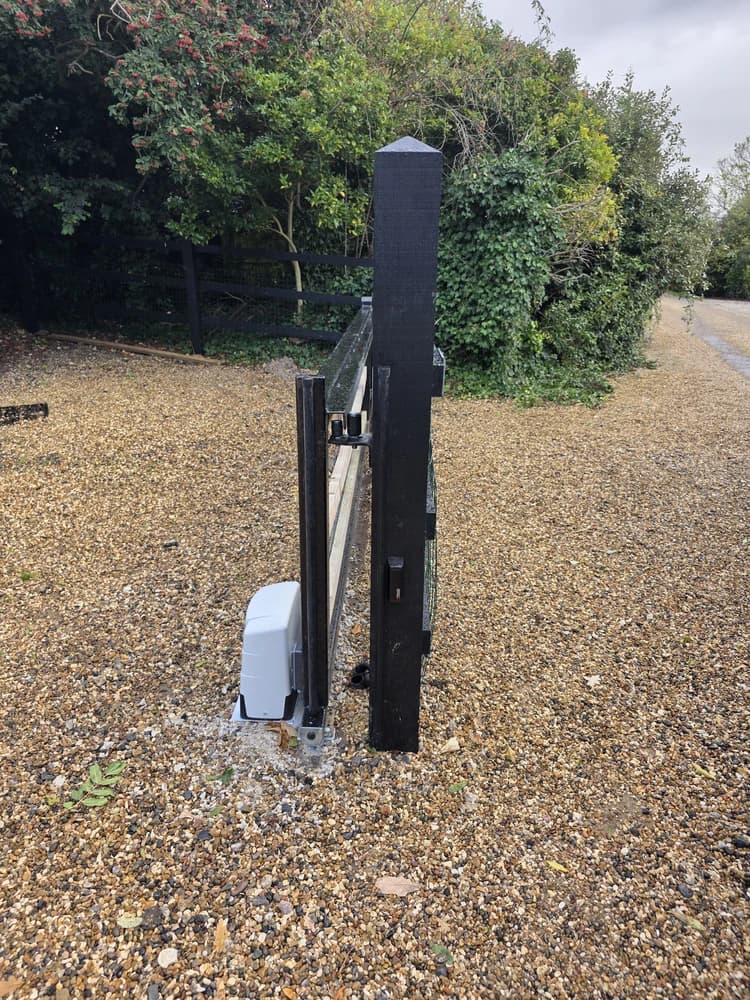
There are two ways to build one. A tracked slider runs on a steel channel set into the ground, with a roller carrying the weight. Cheaper, but the track silts up with leaves and grit and wants sweeping, and it's no good if the ground floods. A cantilever slider carries its whole weight on rollers set in a concrete foundation to one side, so nothing crosses the driveway opening at all. Drive straight over a clear threshold. No track to clog, nothing to trip on, and it works a treat over a gateway that takes standing water. It costs more up front and needs a proper footing poured, usually 1.5 to 2 times the gate length, but for most homes we'll steer you to cantilever every time.
Cost, automation and how hard the gate has to work
Built manually, a swing gate is the cheaper option. Two leaves, hinges, a drop bolt, done. A cantilever sliding gate of the same opening usually costs more because of the counterbalance frame and the concrete footing it sits on. As a rough guide, expect a quality automated cantilever to land 20 to 40 percent above a comparable double-swing, opening for opening.
Automation tells a different story though. Swing gates run off ram or articulated-arm motors, one per leaf, from the likes of Roger Technology and SEA. They're proven and they suit homes that open the gate a handful of times a day. Sliders run off a single rack-and-pinion motor pulling the gate along, and that motor will happily cycle dozens of times a day for years. If you've a busy household, a home that's also a workplace, or any commercial traffic, the slider's duty cycle is the safer bet. Work a swing ram too hard and it gets hot, then the thermal cutout starts dropping you mid-cycle.
Every automated gate we install is force-tested to BS EN 12453 and set up with the right safety edges and photocells, swing or slide. That's not optional and it's not where you save money. A powered gate that can crush is a gate that'll eventually hurt someone.
- Light home use, a few openings a day: a swing gate on ram motors is plenty.
- High traffic, commercial or a long shared drive: a sliding gate's duty cycle wins.
- Either way, the motor brand matters less than the install and the BS EN 12453 force test.
Security and kerb appeal, where each one genuinely wins
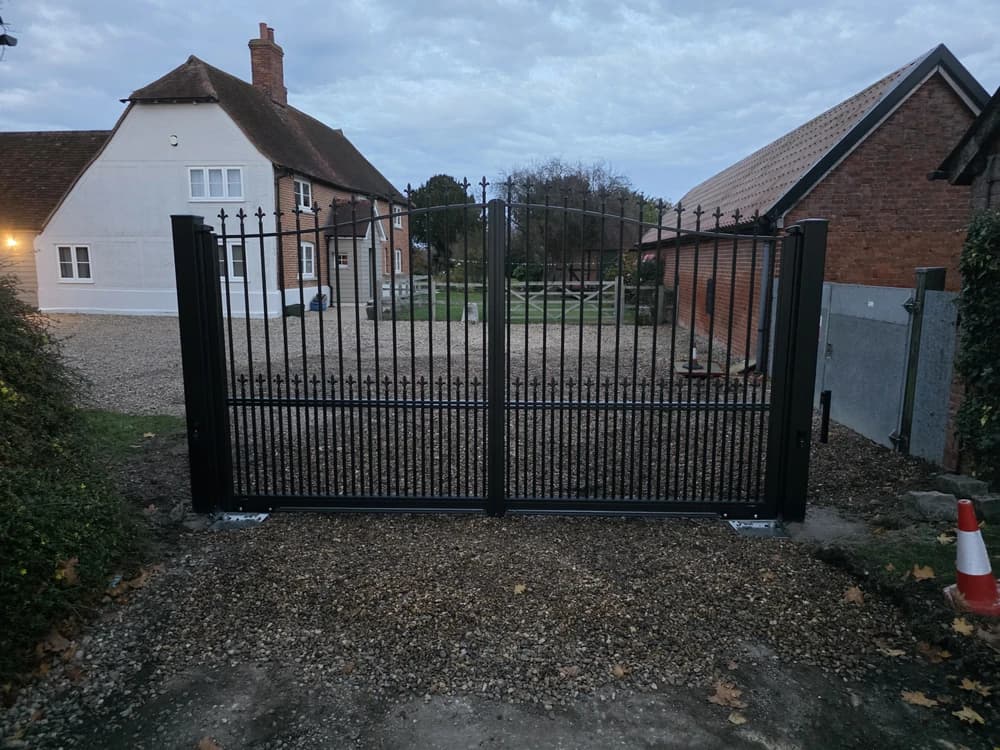
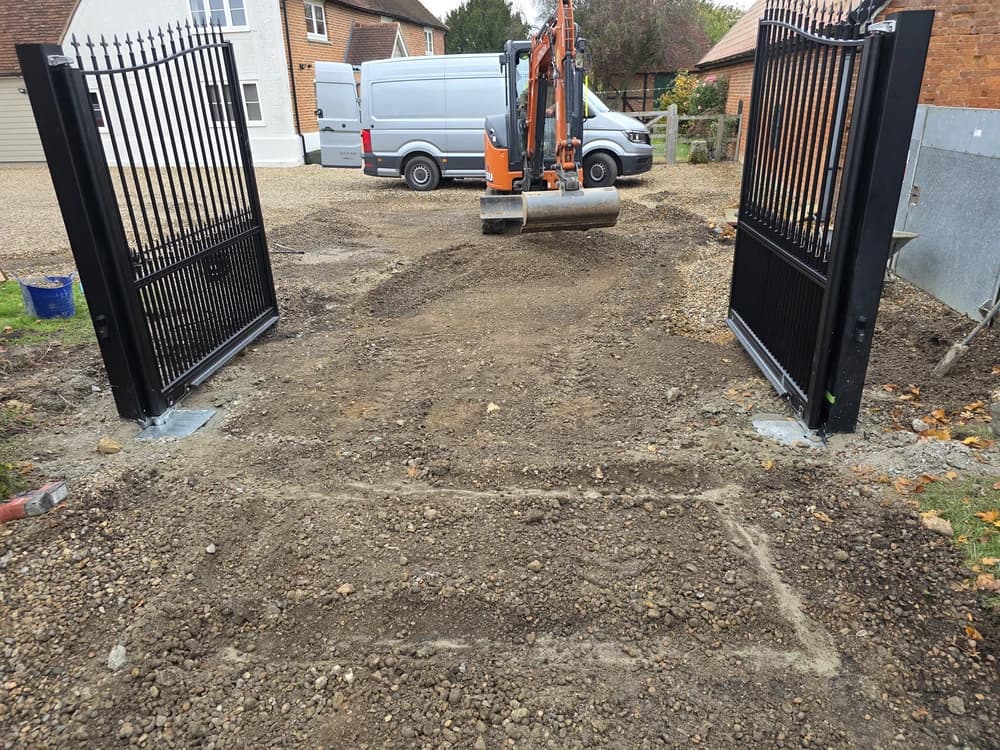
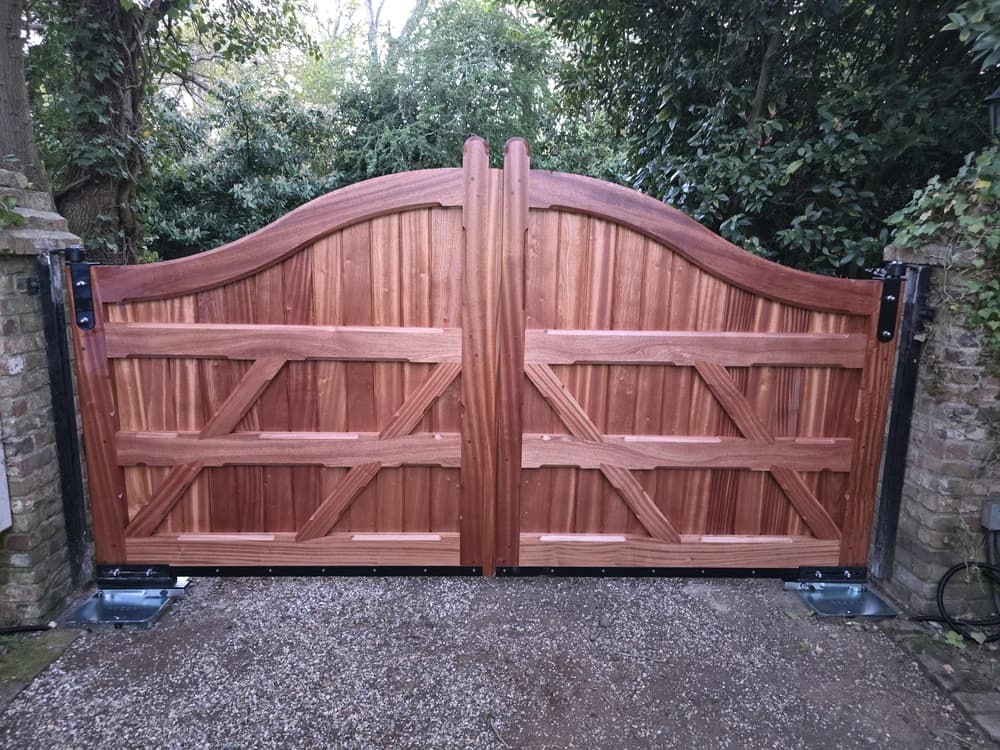
For looks, the double-swing estate gate is hard to beat. A pair of leaves meeting in the centre, bow-top or flat-top, in heavy galvanised steel finished in a deep RAL, says period property. Clad in iroko or cedar hardwood and it's softer again. If your home's the kind where the gate is part of the frontage, a swing gate usually carries it better.
On pure security, sliding gates have the edge. There's no centre meeting point to force, the gate sits in a fixed track or runs off a single solid post, and a tall steel cantilever is genuinely hard to climb or shift. They also pair naturally with access control, a keypad, fob reader, or a GSM video intercom at the gate, because the single motor and run are easy to wire and the gate clears fully out of the way for a delivery van.
So if it's a quiet residential frontage and the gate's mostly about the look and keeping the dog in, swing. If it's a working entrance, a long drive, or somewhere security's the first job, slide.
A simple way to decide
Stand at your gateway and ask three things, in order. Is there a slope rising into the property, or loose gravel the gate would drag through? If yes, lean sliding. Is there clear flat boundary to one side at least as wide as the opening for a gate to slide into? If no, you're back to swing. And how often will it open, a few times a day or all day long? Light use favours swing, heavy use favours a slider.
Most driveways have a clear answer once you walk them. The ones that don't, the awkward sloped-and-tight sites, are exactly the ones worth getting surveyed properly before anyone quotes. We'll measure the opening, check the fall of the ground, look at where a gate can park and how it'll be powered, then tell you straight which way to go. If you want a second opinion on a drive that's giving you trouble, call the workshop on 01206 670305 and we'll talk it through.
- Swing gates are cheaper to build but need clear, level ground for the leaf to arc through, slopes and gravel are their weak point.
- Sliding gates ignore slopes and protect parking, but need clear run-off space to one side roughly equal to the opening width.
- Cantilever sliders cross nothing on the threshold and beat tracked sliders on a gateway that floods or fills with grit.
- For heavy or commercial traffic, a sliding gate's rack-and-pinion motor handles the duty cycle far better than swing rams.
- Every automated gate should be force-tested to BS EN 12453, swing or slide, that's where safety lives, not where you cut cost.